Weddings in Native American Tribes
Most of what I have recently learned about Native Americas came through Helen, my wife, who teaches a course Native American Literature in the English Department at California Baptist University, so through her passion, I feel like I have been to many other Native American events, if mainly through literature. Together we listened to John Chancellor, an NBC commentator about forty years ago, who gave several program in which the Hopi were considered.

Let’s take a trip back on the space\time defying vehicle to a time before Columbus sailed, I would wish to be able to live among the Hopi Tribe along the Colorado River Basin where we discover that the bride in a Hopi wedding wears a robe which was woven by uncles of the groom. I thought to myself how unlikely I would ever have been to win the heart of a Hopi girl with the lack of talent in weaving in any of my uncles. So valuable is the work of the uncles that the wedding gown is seen as a “rehearsal for, or an enactment of, the rest of the bride’s life, even to the detail of a robe she carries for a later ceremony—her burial” (Gourse, 54).
Several days before a Hopi wedding the bride grinds corn with her mother-in-law to be. For nothing is more important for survival of Hopi people than corn, blue corn especially. Meanwhile outside the dwelling the groom’s aunts on his father’s side come with buckets of mud to throw at his aunts from the mother’s side of the extended family. Then the bride’s aunts on both sides arrive with buckets. The latter group begins to insult the groom and the former group insults the bride. Sometimes the father of the groom is captured and has his hair cut as if a mock scalping. “At the end of the fight, everyone is exhausted, filthy and hungry, but everyone joins together to enjoy a feast, and the bride and groom are supposed to lie happily every after” (Gourse, 56).
Now in the prior to coming of the white men, let's imagine the Cherokee Tribe in the mountains of what would become North Carolina in a future century, we discover another wedding taking place, for on the day before the wedding the relatives of the groom gathered outside the house of and consulted with the brothers and uncles on the maternal side, then, if things work out for a wedding, the bridegroom needed a blanket and other objects of clothing to send by his female relatives to those of the bride. If they accepted them, the “match is made.” Then the groom could go to the bride's house. until he builds his own house and on a hunt finds food for her to eat (Noss, 32 using a manuscript of William Bartram).
As otherwise in the "album project" I have used children's books as rich sources to understand weddings in ancient Greece and in Medieval Japan, I was shown a wonderful tale of "the White Pony" written by Sandra Byrd and illustrated with paintings by Sarah Waldron.
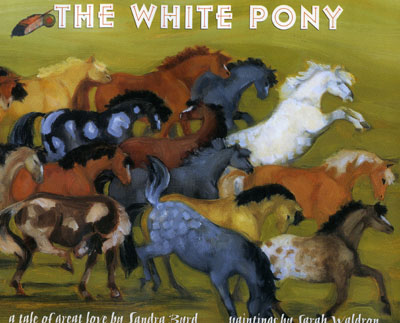
image: whitepony1
The cover of the book in the image above reveals the high value placed on horses by this unnamed native American tribe. We learn on the first page of the text thatthe tribe is a gentle one and the women pound grain while the men hunt and trap horses. One of the braves, named "Starlight," imagines someday that he will capture a horse as gazes into the heavens, from whence his name comes. He hears of a white pony during story telling times and makes it the object of his desire. Ten years pass after a great rain and it is times for him to choose a bride, during which time he has also acquired a white pony, which he loves best of all his animals.
.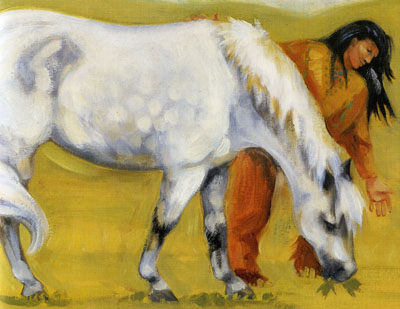
So as "Starlight" starts his search for a bride, he observes young women of his tribe. One young woman he saw was beautiful with rich braids. Another was smart and could weave plants into threads and make patterns. A third could always find berries and roots, thereby being able to feel her husband quite well. Finally, he saw a young woman, let's call her "Forget me not" who was not beautiful, nor could she weave or find food. But when he heard her calling to a baby who was crying, our brave young horseman was touched by the tone of joy in her voice and wanted" to share that joy with her"(Byrd, unnumbered page 14).
So he goes to the girl's father in the way of his tribe and asks the father What will her bride-price be?
The father suggests that one pony would be enough. The brave agres and returns in seven days to claim his bride, but other young woen make fun of a bride that would only require one pony in the price for her wedding. Starlight hears the gossip and sees the sadness in "Forget me not's" face, so he asks what the largest price ever paid for a bride and learns it was twenty ponies. To outbid any previous bridegroom, he manages to gather twenty ponies and then includes even his favorite white pony which he takes to his future father-in-law.
When he arrives at the village with his twenty-one ponies, the father-in-law says they agreed on only on pony, but Staylight clls out "My bride is worth more than al others in the history of the tribe." Here are twenty-one including my favorite."
so...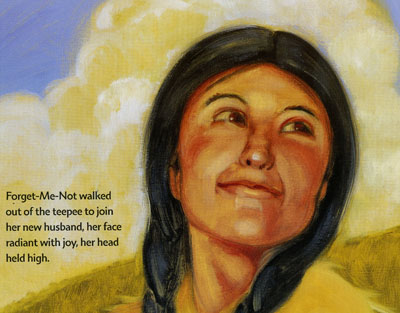
The story ends with a strong Christian ending that I did not expect, but it is a story of love for Starlight held his bride in such high estatle that he was willing to give all he had to make her his wife, "not because she could offer him anything, but because he loved her." (Byrd, next to last unnumbered page).
Somehow Byrd has captured a love story leading to what must be a happy ending in a wedding which happened a thousand times in native American tribes with different numbers of horses and ponies. They were the most valuable things tribes could acquire after the White Men brought the animals to America. The illustrator, Sarah Waldron, must have looked at many paintings by native Americans to sense the clouds and sky in the dreams of artists who sketched on the canvas of their tee-pees to prepare her for this wonderful story.
I have only attended one wedding of a young man who carries the blood line of native American people. (Cf. "Weddings of faculty" then "Joanna Ifft and Tom") to which they brought a different story and history but with a blessing that might have easily been included in this story of the White Pony.
Another gift for Native Amerian weddings of the Pomo tribe in Northern California is a coiled basket,"called CHI-MO-PI-KA is a present created by the bride's mother and given to the groom as a present" (Kletchka 25).
The coiled basket has a purpose beyond the wedding for it becomes a family treasure to be saved, even protected for the life of the couple. Moreover, upon the death of either parner the basked must be ceremonially destroyed. It seems thereby to serve in the process of grief of the remaining partner.
It is made from " clam shell and glass beads that spiral up the sides from the base to the rim, following the darker duck-wing design of the basket. Brown quail topknots and small, red woodpecker scalp feathers further enhance this pattern, covering the lighter areas of the surface" (Kletchka 25).
The tradition of making and gifting of these baskets is threatened by many issues, as fewer and fewer learn how to weave the baskets and the birds with their feathers as contributions are decreasting with the encroachment of humans and their pesticides. Like many other tribes these traditions of weddings and other celebrations are threatened.
In the wedding of Joanna Ifft who married Thomas Charles Duran, discussed below in "Weddings of Faculty," they had us all recite a Native American blessing as follows:
"Now you wll feel no rain,
for each of you will be shelter to the other.
Now you will feel no cold, for each of yoou will be the warmth to the other.
Now there is no loneliness for you.
Now you are two bodies, but there is one life before you.
Go now to your dwelling place,
to enter into the days of your togetherness.
And may your days be good and long upon the earth."
|