A Conclusion and Appendix
A Conclusion and Appendix
I. What does this "album annotating" mean to me?
One of my brothers made an astute comment, when he said, "Bill, you wrote about our weddings and many others. But what you have sent me is not what you claim. Instead, you have written a strange kind of autobiography in which you appear on every page, growing older over the years, showing that you can remember some weddings along the way, and trying to figure out something special which happened in the weddings you did!" I must agree; but I amused myself in the process, more than anything else I ever wrote. I found the topic allowed me to remember and reflect over my whole conscious life, and I tried to reach each person I wrote about; also I learned a few things as well. Another critic has called this “album project” “creative non-fiction.” She is also a professor of English who teaches that genre, so I have tried in the preceding remarks to live up to the term. The weddings in the “Decades” are non-fiction, I can assure you as are the stories I tried to remember. If there is anything “creative” maybe even fiction as well, it is in the “Weddings around the World.”
Recently a wise friend on campus, Ms. Denise Spencer, asked, "What are you doing, I have not seen you all semester?" I responded, "I am trying to remember a hundred or so weddings I performed, attended, or "crashed.”
"What do you get out of that?" Denise asked.
"That is a good question" I answered, "It is not the money.” One loses money by taking split Sabbaticals. Also I refuse fees for "doing weddings" from students who have passed my classes. I think what I get is the chance to share a very precious moment with people I would might never see again. Their wedding might very well turn out to be the most defining moment of their lives!
"Wow! that is a lot to expect from a wedding. I have never been married and hence never "had" a wedding. It must take a lot of courage to get married"! Denise concluded.
Her conversation haunted me, and after I went back to my computer, I thought, "It must also take courage to conduct weddings!" In performing a wedding, a rabbi, priest, pastor, chaplain, ship's captain, or civil servant represents the State of California (or any other civil authority) in signing the license. But one is doing more than a notary public, who signs a form saying he has seen a person signing a document. Instead, we are affirming we have heard a vow, an oath, a promise of two people to share their lives. But do we have a responsibility to do more than sign such a form saying that on one day in a specific place two people appeared and share a promise?
Until I started this "album project" I had not pondered that last question or the one about what I would be getting out of it. Even now, I do not know the answers. Some of those whose weddings I remember, for a couple to whom I wrote letters, did not respond. They either moved away giving no address to the alumni office or did not consider my role as anything more than a "signer of a document."
But many others, let's say about 80% of those to whom I wrote, responded with memories, with pictures of their wedding and/or children, and sometimes with shocked appreciation that I still remembered them. As I performed all these weddings or went to others when invited, I had no idea I was collecting materials to write about in "this album project." But later, just as I was cleaning out my office for a move down the hall, with a Sabbatical leave coming up, I went to see "Wedding Crashers" and discovered that I felt just like the priest who kept doing weddings in that film. He sometimes looked puzzled, sometimes pleased, and once or twice delighted to see the same people appearing,again and again.
Anyway I came to feel just like that priest, and I had a file of licenses and often pictures from my own camera, and some pictures sent from couples thanking me for giving them a wedding. Thus, at first, this project was just a challenge to see how many weddings I could remember after 20, 30, or 40 years. So before senility sets in, I started organizing them, with no more aim than sticking the pictures on the ceremonies (which I always tried to keep) and attaching them to the licenses. Then one day I realized each ceremony was different, each wedding had a story or two to be recalled, and I began to type them up.
So while weddings might be boring to a person who does 7 or 8 a day like the Chaplain to the United States Naval Academy on the week of graduation at Annapolis, where actually I happened to be present in June l956 when my ship, the USS Iowa (BB-61) once steamed up the Chesapeake Bay to pick up midshipmen for a summer cruise; I remember going I went to look at the Chapel and sat down for a wedding. By contrast, for me "My weddings" were never boring, and I never did more than one in a single day, more than five in a month, or more than eight in a year. Usually weddings were scattered over fall, winter, spring and summer in a variety of places. They could take place on a mountain, by the ocean, in a park, or a living room. Two weddings took place in Skiathos, Greece.
As well as to bring back memories of weddings, some long ago or far away, I discovered another purpose in writing became a chance to share these ceremonies with students, friends, and family who are planning their own weddings. That purpose has already proved valuable it seems!
II. How did it get started, and what was the process?
I was aware from the first weeks of my Sabbatical that the research for my "album project" was quite different from going to the Huntington Library to read the papers of Thomas Jefferson or of Yone Noguchi. To research the weddings of many students I taught and of families I love, I found a personal joy in connecting with some folks I had lost all contact. The project also gave me a chance to read again from some of my most ancient and beloved authors and to discovery that there is an academic field one might call “weddings” as well as a booming profession with many non-academic publications.
This project started in January 2007 when I first sent out letters to those whose weddings I remembered, but months went by with no answers. So I let my imagination run wild and imagined weddings I had not attended nor was invited to attend. The segment "Weddings around the World" was the result. Inspired in part by the rich imagination of Dr. Martin Luther King, Jr, when given his call by God might have been to other times and continents in a great sermon, (King in Warner). Thereby, I became a "wedding crasher" at several important weddings, the first being of Adam and Eve, where perhaps the snake and I were hiding under a bush. (Cf. "The wedding of Adam and Eve). Even when the responses of a hundred couples I married starting arriving, I kept imagining myself as a "crasher" with the last such wedding of Chelsea Clinton (under the "Decades” then "2000 and beyond."
Meanwhile, as I waited for responses from those I wrote or called, I found myself reflecting on travels I had made to Greece, England, Ireland, Japan, Taiwan, and India that inspired the "Weddings around the World" selections. I grant that those ten "chapters" were more like a photo album of a journey than a wedding album. Yet some of the most interesting reading and photograph scanning in the whole "album project" appears there.
Some colleagues my find my research very "off-beat" as one said and based on an inaccurate database. He told me I had too few people for a "comprehensive" database from which to write about. “Fair enough,” I said, “but this is an album, my album, not a peer reviewed scholarly article. You can find enough of those on my university web page of publications.”
As to my background, I have never had more than temporary assignments as a minister in a church, where relationships developed in weddings. Moreover, as I stated on the “homepage” above, I was not attempting to track the "success or failure" of the weddings as to whether the marriage was successful. Every wedding I did and attended was a success, even the one I included with the “teddy bear” as the illustration.
The comments here are intended to allow me and my “couples” to tell stories about the weddings and to remember some details of the day they married. Often, their responses to my queries let to pictures and comments about the children who were usually born after the wedding.
Some ministers in big churches can perform a hundred weddings in a couple of years. Moreover, in Japan some Americans, who speak no Japanese, perform weddings for people they only meet for the hour of the ceremony, with eight weddings in one day could easily perform one hundred weddings in one month. By contrast, "my album project" contains weddings over the span of fifty years, and almost all of the couples were in classes or are colleagues or friends. Very few couples were strangers, when they came to my office, and always they were referred to me by someone I knew well.
Moreover, I never have tried to get any couples to join a church or to take a class with me, or to have me say anything they did not want said at their ceremonies.
As to the research above, I can say that my starting point was the file in my office of wedding licenses that I signed over the last 50 years and the many pictures I took. Many pictures had names and dates inscribed on the back of them.
My first steps in the process of researching for this project was to write letters, send emails or telephone every person whose wedding I attended or had a part of performing. I asked each couple for additional pictures and for comments on what they might remember about their wedding ceremony and thereafter. Some were quite detailed with surprises for me. (Cf. Ron Naylor's wedding in the “Decade” then “l964-74”). The research for this project was the most inspiring of anything I ever published, for I was trying to remember and describe some very special days.
The process seemed incomplete when the Sabbatical in the spring of 2007 ended. For I had remembered many more weddings than in 2007, and I went to eight more weddings in the next two years. Two were for faculty, two were for students; and I was invited to two more that I did not have to officiate; all inspired my thinking. I was amazed to attend two in Greece, which expanded my horizons. Two were for children of couples I had married in the l970’s. (Cf. The weddings of Maren Bennett and Megan Smith, were discussed as if extensions of their parents’ weddings in the “Decade” then "l974-86").
I am grateful that during the fall semester of 2010 I got another “split Sabbatical” to focus on these special weddings and to revise and reflect on the ones already considered.
Here is a summary of some music, poems, essential elements in ceremonies and suggestions:
(1). Usually a wedding begins with music, which sets the tone. Below are examples of recordings:
"Music for Weddings and Other Celebrations" (1999) London Symphone Orchestra and Royal Music College Edinburgh. Trenton, JN Fine tune, LLC. This CD inclues Mendelssohn's "Wedding March from 'A MidSummer Night's Dream,'' Wagner's "Wedding March from 'Lohengrin,"" and Purcell's "Trumpet Voluntary" (the last selection was used in the first wedding discussed above in "Decades" "1960s").
"A Classic wedding." (2004 Santa Monica, CA: SLGG.LLC. This CD incluedes Mendelssohn's "Wedding March," Handel's "Music for the Royal Fireworks," Mancini's "Moon River," and Vivaldi's "The Four Seasons."
(2). Next comes an introduction, sometimes called a “Gathering.”
(3.) Then come a prayer, a homily, even a sermon, if one follows Luther's example. As a Biblical scholar, I often read selections from the Bible; and couples often picked Paul's " First Letter to the Corinthians 13 or a selection from K. Gibran in "the Prophet, sometimes a poet like Shakespeare or the Brownings, and on a train from Edinburgh to Oban, I met a Scot who saw me reading from the poems of Robert Burns and at my request read "My Love is like a red, red rose" aloud to my fellow travelers, after which he cried and told us the poem had been read at his own wedding! (Cf. the appendix, which follows for many other suggestions.)
(4). Then come the statements of intent and the vows. Often I ask the bride first if she came be married to "this man" whereupon with an answer of “I do” or “I will” I ask the groom if se came to be married to "this woman" or more often by their given names.. Then come the vows, such as: “…in sickness and in health” often followed by music again.
I especially I like a vow I found for an older couple which I have not yet used: “Because of you, I'm no longer lonely; because of you my life is brand new; because of you, my heart is singing with no more sorrows, no more tears. Because of you, my days are filled with hope and excitement, just to be with you, letting your love soak into my dry bones until they are strong and filled with your energy. I am young again, dear, all because of you, I need you now and always, every waking moment and II freely and wholly give myself to you this day, to be your loving and faithful husband (or wife).” (Warner 111). (I imagined this vow would have been possible for my father who re-married at age 75, after my mom was killed in a car crash. I know he felt this way about our step-mother.)
As for the vows, I was reminded during this research of how difficult it is for many couples to live by the vows they promised each other. I laughed out loud in the library when reading a comment of George Bernard Shaw, “When two people are under the influence of the most violent, most insane, most delusive, and most transient of passions, that are required to swear that they will remain in that excited, abnormal and exhausting condition continuously until death do them part”” (Shaw, qtd. by Camp 272)
(5). Then comes the exchange of rings. I discovered that the father of the bride gave rings in Medieval Jewish weddings to the groom. That was a surprise. For the circumstances that have led to double ring ceremonies I suggest the following article by Howard (2003) on the origins of the practice.
(6). A concluding statement, often with a prayer.
(7). The pronouncement: “I declare that the couple are husband and wife.” I often deliver this line, as if the audience is of several hundred people, with a flourish as if a trumpet would sound in the background.
(8). A kiss seems to ratify the fact that the wedding had concluded which is followed by an exit, almost always to music.
(9). Include a note about the photos (“Kodak-Moments”). In a Japanese ceremony going for the photographs is often the final item on the printed program.
Looking back to 1964 when I wrote a dissertation entitled "Christ the Bridegoom: a Biblical Image" I looked for roots of the image in the Hebrew Scriptures. In the "album project" when I discussed Hosea I might have implied that he created the wedding ceremony as a form. Actually, he used an already much used form for a wedding event to show in a new way an understand of God to his people as like a marriage.
Other prophets also used this analogy, as for example, Ezekiel. His use of the form has five parts. Notice how his "wedding form" might be compared. essential elements in the wedding ceremonies of today. I discussed form as follows:
1. The setting. The groom looks us bride at the "age of love" (Ez 8a). This might be somewhat like a "gathering" statement above.
2. Initiation of Marriage. Here the bridegroom speaks in the first person to the bride and he gies his word to her as in an oath (ve'eshiba' lek) and enters a covenant with her (wa'abo' bivrith (Ez 16:8b)This compares with the statement of intent and makes a covenant.
3. An act of Cleansing (Ez 16:9a) Which would not have a comparison with modern ceremonies, except as implied in the act of bride and groom getting dressed espedcially important in China and Japan.
4. Gifts. Oil, clothing, ornaments, and food. (Ez 16:9b-13). This step has strong parallels in ancient times and in China, but it might be seen as the giving of rings, which also appeared much later in Jewish weddings, first from the father of the bride to the groom and today in most weddings in "my album project" as a double ring ceremony. My colleage Dr. James Malcolm while discussion weddings in a private conversation reflected that today the ring represents the financial dimensions of the couple's expections "reduced to a simple band of gold, sometimes coded with words of promise."
5. Proclamation withe the line "all nations come to know" (Ez 16:14). Thus for Ezekiel in Babylon where his prophecy was made, the wedding took place in a public arena and not only for the couple but in a sense for the whole world (Huntley, 1964).
This discussion may pose the question as to whether there are any essential items that people around the world hold in common to agree upon at a wedding. Usually one would expect that the people entering into marriage would come to the same place and time, having promised each other to agree to the marriage. By good fortune all the weddings I conducted had two people present, but I was told by an authority, now deceased, that I could sign the license, it I could later prove “intent” of both parties to be present. So far I have not signed a license in the absence of either the bride or groom. It is, I believe, possible.
Also expression of consent by both parties would seem necessary, if not spoken then acted out or having an agent so act, In California the couple must go to a court house and request a license which is valid for so many days, after which it expires.
In Jewish ceremonies, the couple makes a commitment to each other based on trust and hope. The male seems to have spoken, and the female seems to have agreed, at the ceremony or before. Stepping on glass represents the sealing of vows, and that moment is often the most memorable moment in the ceremony.
All the weddings which I have ever performed, save one, had one bride, one groom, and at least two witnesses. The one couple, who appeared at my office in Larsen Hall with no witnesses, were rescued from failure by Dr. Bud Watson and Mrs. Linda Hunt who served, if briefly, as witnesses. But in this case, I had already heard their vows in the San Bernardino Presbyterian Church, although they had forgotten to get a wedding license on their earlier wedding ceremony, pictured in the album. I have no picture of the second wedding ceremony, only of the baby they brought to show me.
One friend recently asked if I was planning to write about music. As for music at weddings, an excellent list is provided of some classical pieces as follows:
Bach: Brandenburg Concertos #2 and 3;
Bruch: Violin Concerto in G Minor;
Mendelssohn: Violin Concerto in E Minor; …
Vaughan Williams: “Fantasia on a theme by Thomas Tallis (Arisian 151).
During the research for my "album project", I interviewed several members of the distinguished University of Redlands School of Music about weddings, and one of them reported, “I do not play at weddings.” One said that he would play if the price was right, and another started humming a tune from his own wedding, and asked if I recognized it. I did not. Some weddings discussed above had organs in a church, a quartet in a garden, or a flute in a forest. Each seemed appropriate to the couple.
What should be played? I discovered in my research that Protestant, Roman Catholic and Jewish weddings can call for quite different musical selections. For example, Protestants more often have the Bridal Chorus, Lohengrin by Wagner, the best known piece ever written for a wedding when the bride comes in with her father (or mother, or both) while Catholics are offered a Bach piece for the groom and the priest, and Clark's The Prince of Denmark's March) for the bride and her father. Jews might choose a cantor to chant Dodi Li (I am my beloved's) followed by the organ playing Hanava Babanot, (Beautiful One) for the procession of bride and groom (Blum 116-118).
Kathy Ogren's ceremony (Cf. under "faculty" with the actual music on an “I-movie” can be heard A whole one hour VHS was shot of the entire ceremony, of which the “I-movie” selections are only a few minutes. Her guests included a host of singers, a guitarist, and a flutist. More important, she married a groom who could sing his vows.
Against the overwhelming romantic mood that often accompanies a couple planning a wedding, I nearly always tried to bring a feeling of realism into our discussions about the wedding. I have sometimes quoted the Yiddish proverb: ”Love tastes sweet, but only with bread.”” (Browne 639). As my readers observed I am tried to avoid suggestions for weddings outside the ceremony whose words and jusic I did discuss. I always let the couple pick the setting and helped them work on the words of the cremony. their musical choices may not resemble mine mine. I have always avoided financial dimensions when discussing weddings. I did learn that one wedding in this "album project" cost the father of the bride $40,000 and another probably only cost only $40 for a huge Subway sandwich 20 feet long. But I recently read that the wedding of Prince William in April 2011 will cost $40,000,000 and only half comes from his family!
In that regard, I got hungry several times this semester, thinking about some receptions I had attended, and I grew hungry sometimeswhile looking at the pictures of tables in Weddings Southern Style. (Church1993).
As for prints and videos, I would suggest couples finding a professional. Had the all couples I wrote about done so, my “album project” would look more professional. Alas, most images in this "album project" are from my own cameras. At one wedding for the son of Dr. Jonas Salk and the sister of a University of Redlands student, held in Temecula, CA, where I was asked, “Would you be willing to be the ‘back up minister,' in case the San Francisco Mime Troop, who had agreed to perform the ceremony, could not make it to Temecula, in time?””Fortunatley the Mime Troop did arrive, so I did not perform the wedding. But unfortunately, although I brought the video, I failed to turn it on!
At this point in writing this conclusion, I received an important and powerful letter. Perhaps there are a dozen or many more folks out there, who by not responding to my requests for pictures and updates might wish to express just the sentiment of this letter. The letter leaves me with a sad but realistic sense of a quite different side of my “album project.”” Fortunately the author agreed to let me use it, and I decided to delete both names. It is as follows:
"Dear Dr. Huntley,
First, all pictures/video I had of my wedding … I tossed in a bonfire. The choice was either that or a more successful second suicide attempt.
In my youthful ignorance I believed in and was comforted by the idea of getting married to someone with whom I wanted to have a lifelong connection. The marriage lasted 12 years (plus 11 years prior of monogamous dating). (Her) take on the marriage in retrospect was that it was a "social imperative" so as not to disappoint our parents.
The breakdown could be attributed to the classic power struggle of who was more controlling but ultimately she said that I loved her too much and she needed her freedom to be happy. I desperately tried to keep her from leaving at least for our two young children's sake, but to no avail. She even moved back in for nine months after she divorced me in 2004. Turns out I was only comforting her as her first post-marriage boyfriend had dumped her. A bit of irony being the last time (She) and I went out together was on New Year's Day 2005 at Marie Callender's where we sat nearby you(the gesture of greeting the one that married us seemed too odd as I knew (she) was securing yet another move-out.)
(She) has since remarried and I do my best to provide guidance and support for our two children who are clearly as puzzled as I am over the events of the last few years. At least she didn't marry an abusive prison guard with kids of his own...no wait, she actually did do this! I'm single and unattached and plan to remain that way.
Apologies for not getting back to you so that you could have checked me off your list sooner. Sincerely, NN."
His comments serve as a reminder that not all the weddings I performed would endure "as long as life shall last." In fact of the 7 marriages among my brothers and myself, five have been terminated, and only two seem to be headed for the "Golden Anniversary."
I am feel certain after the research in this "album project" that the weddings discussed above are far more lasting than the national average in California. Perhaps the reason is that mainly I have been conducting weddings for people who were colleagues or students in my classes who brought their deep thought and great energy to making public vows.
Nonetheless, I usually tried point out that little I might say at a wedding will hold the couple together. I have affirmed that the marriages which follow wedding days are dependent upon the way each couple takes responsibilities in the days, months, and years which follow their weddings. So I sometimes warned with a note of realism as to what was ahead for a bride and groom with the Yiddish proverb "Love tastes sweet, but only with bread" (Browne 639).
III. What surprises were uncovered in the process?
When I started to perform weddings, I had no idea that I would be writing many years later writing about them in this “album project.” Certainly, I have kept pictures in a now battered looking album with names and dates. Moreover, when I got to California I learned I was required by law to keep copies of the licenses which I had signed.
Somehow pictures appeared, some quite professional from the weddings of the 1950’s of friends and my dear cousin Mary Ann Tilley. Then came the weddings of my family.
Then I got a job teaching religion and as chaplain at Westminster College, in Missouri. About ten weddings took place during my decade there. Two were took place in our living room there. Another wedding was performed in my black robe in the 17th Century church, designed by Christopher Wren after the London fire of 1666, but moved from London in the l960's to Fulton, Missouri. Three weddings from that decade took place in California.
Suddenly the world changed when I started to teach at the University of Redlands. Students who had taken a class with me or who were in the Alpha Gamma Nu Fraternity started asking me to perform their weddings. Meanwhile, I acquired a more medieval looking gown, which my daughter called "Gandalf's coat." I found inspiration in Arisian's The New Wedding: Creating your own Marriage Ceremony, to whom I should dedicate these reflections. I have bought and worn out three copies of the book, loaning them to students over the years and asking them to find words in the book that they would wish to have said at their weddings. Arisian offered eight quite different ceremonies from ones with traditional language, which St. Paul used, to the first century Corinthian Church to one that was written for a feminist who was to be married to an anarchist. I should affirm that the ceremony most often selected by "my couples" was the wedding Arisian composed for his own wedding entitled "Reaching Out" (104-8). I should add that so far no couple has asked me to use the language that the feminist and the anarchist use in their wedding (94-101). There is still time, I trust, but probably I shall never hear the words, "We love each other, but we do not want to get married except for reasons of prudence. We do not want to get married, because we do not regard the state as having the authority to regulate and define our relationship to each other...."(Arisian 96). Perhaps in the debate which rages in California and seems headed for the United States Supreme Court in the coming year, there will be couples who echo that language.
As one reads through the "Decades" the costumes seem to change, the ceremonies change in style and tone, and the heritage in the gene pool of the couple widens. The weddings I attended in the l950’s and 1960’s were all for Anglo-Saxon descendants
The weddings of the l960's of my brothers and of the "weddings of friends and faculty" are celebrated "moments in time." Those weddings are somehow part of a "family and friends’ story" evoking ongoing discussion. In contrast, I thought I had lost touch with most of the folks whose weddings I performed while at Westminster College; so to find so many of them alive and well and still in their marriages is more than a testimony of the stable and conservative nature of the American Midwest. Those weddings are perhaps testimony to the sincerity of promises by many who wanted their weddings to be enduring. As for the weddings at Westminster College, I did not perform the wedding for Craig Clark in Scotland to Grace, but he was a kind of "prime mover" to the "album project;" he even reminded me of weddings I did for his fraternity brothers. He stayed in touch for thirty years and tracked me down in California, then enrolled his daughter Clare-Marie to the Johnston program at the University of Redlands. Now after her graduation he wrote me to say she wanted me to perform her wedding, even though she had not yet selected her life partner. That was a surprise with a future dimension!
IV. What changes took place in weddings?
Over the course of fifty years, since I went to the first weddings I can remember, much seems to have changed. We have had eleven presidents of our country (some whose daughters were captured by me as suggesting historical contexts for what I wrote). We have become involved in four wars and some "police actions." We have seen debates on what marriage should be, or better, should not be. Many of the couples who marriages I attended or performed were already living together. All of these couples knew more about sex than I did at the time of my own wedding.
One surprise in the process of writing about weddings I actually attended or performed over the last fifty years is how much has changed. From my use of the traditional ceremony in the Book of Common Worship (Presbyterian) and the Book of Common Prayer (Anglican) that I used forty years ago, I have come to include in this "album project" some very open and creative ceremonies starting with use of Arisian's anthology of 13 ceremonies to some weddings for couples who come from Buddhist backgrounds, Muslim and even a follower of Shinto.
Another surprise was to remember the variety in settings for weddings. Starting with weddings of my brothers in churches and at Westminster College in the Christopher Wren designed chapel that was formerly the Church of St. Mary, Aldermanbury in London in the 17th Century until a Nazi bomber took out the roof, I moved outside mostly to weddings. One wedding took place on Mt. Tamalpias near San Francisco in l969, my first outside. Then came weddings in S. California at the Assistencia or just outside it for Walt and Barb Smith (1978), in the Huntington Garden (illegal as a place but nonetheless a choice of my brother John (1980), at Stillwater Vineyard near Paso Robles for Maren and Jeremy (2008), in Nostos Taverna in Skiathos for Rob and Barbie Neufeld, and in the Wild Animal Park in Temecula, CA for Meghan and Ryan (2009). The influences of the setting of these places led to the creation of different ceremonies appropriate to the setting and more to the beliefs of the couples who brought quite different views to live by.
The earliest images in this “album project” are of folks having “traditional” weddings from the Presbyterian Book of Worship. Thereafter in the l970's I discovered Arisian's book of quite varied ceremonies and went to a wedding conducted by the San Francisco Mime Troop (cf. "Decades" then "l974-l986"). The attire we wore became as varied as the ceremonies.
I have been involved in weddings in churches, college chapels, and other sacred spaces. Over the course of fifty years, many couples have wanted their weddings held outside, such as on a mountain or within sight of a Greek beach. Because I am not a parish minister whose work is seen as connected to any particular church, the weddings I hae done can be anywhere the couple has chosen. Many of the weddings I have performed have been outside, and in the process of writing in this album I discovered my own parents were married in a garden, and since most weddings were for students who knew me in class and had already perceived I was a "little weird" they expected the style of the wedding to be somewhat unusual. Yet, I rejoice when some couples wish to be married in a church or synagogue (Chesser 204). For example, the wedding of Steve and Becky Wiens took place in the First Baptist Church of Redlands, and the wedding of Mark and Janice Steffens in the Wayfarers Chapel near Palos Verdes; both were all the more memorable because of their settings.
If there were changes in the wedding ceremonies, there were also huge changes through the invention of personal computers. Many technical changes took place in the decades since I unwittingly began this project. Imagine a world in which there were no computers and web pages when I went to my first weddings. At least there were cameras! Now at last thanks to my good friend, John Fearon, I have a digital camera; but some of the earliest images were from a 1970 Pentax that put things in sharp focus in those days. "Adobe Photoshop" and "Adobe Dreamweaver" allowed movement from the pictures to texts, and back again. I also realize II was too dependent on my own photography. I should have paid professional photographers at the time they shot weddings, and I have tried throughout this "album project" to give credit where is due. I must mention the best of all photographers whose work I used, I must give some kind of award to Jesus Garzea who shot Lillian Larsen and Stephen Klein's wedding. (Faculty: Check out his web page: http://www.jmmgarza.com/). Will a seafood meal count?
V. What changes took place for "the performer, "crasher" etc?
Many times at weddings I have been inspired by the conviction in the voices of those whom I heard say their vows. The ceremonies that many couples composed wrote or edited for their weddings were ofen more profound than the vows I remember speaking myself. Consequently, I found myself being inspired by their words or music. Also from time to time I have watched guests or family members at a wedding simile, cry, or turn to the person next to themselves and affirm, I hope, some memory or feeling from their own wedding vows. Sometimes a wedding seems often more meaningful to guests and families than to the couple of the hour. But hopefully the bride and groom will later attend other weddings, as I have now done for a hundred times, and somehow affirm the vows made years ago with different words and renewed feeling.
During my the thirty years in California, I have conducted weddings for people of diverse backgrounds, including colleagues, friends, children of friends and students from almost every religion I have ever studied or even imagined. In each case, however, I have tried to get the couples to engage in some soul searching” as they framed their own words as vows. One should spend a good deal of time talking to partner about what marriage means to each other. I suggested that they make a list of vows they find particularly meaningful, and of anything they find outmoded or offensive” (Church 149).
In the last decade it has seemed very easy to conduct a wedding for a couple with ancestors from different continents on this planet. I am pleased to have performed six weddings in which the couple carried the genes of different continents.
In the last decades, I was able to attend and perform ceremonies for at least three Afro-Americans who were celebrating a wedding with a bride bearing the genes of European ancestors. I found myself rejoicing that the "dream" of Dr. Martin Luther King was already extending into weddings as well as social respect and equal employment. I also attended weddings for brides who had ancestors in Asia and men whose roots extend back to the immigrants from Europe. If such weddings were a surprise to me, they were even more a joy to celebrate. Need I remind the reader that such weddings were not possible in the American South where I grew up?
While Jewish rabbis may be hesitant to attend weddings unless both bride and groom are Jewish or converts to Judaism, I can count back to several weddings I performed or attended when only the bride or groom was of a Jewish heritage. That would have been an unlikely possibility in North Carolina or Missouri in the first years of my going to or doing weddings. One Jewish bride in this "album project" honored me by inviting me to read the Hebrew text of a Seder (Passover dinner) at her home!
I learned a great deal about Jewish weddings I had never imagined, such as the fact that weddings cannot take place for Jews on certain days, such as on Rosh ha-Shanah, Passover, Shavuot, and Sukkot (Schneid 20). I soon realized that have never been to a wedding on Christmas, July 4th or Easter. So there must be days when Christians also tend to avoid for weddings.
Often in this project, I remembered conversations with couples who came to me, and we discussed topics which did NOT end up in wedding ceremonies
For example, some years ago, a young woman (without her "groom") came to me for advice. She told me that she had not told her “groom-to-be” that she had had a long and deep relationship with an Afro-American, whom she still thought about. She asked me if she should tell the "groom." I asked if she and her new boyfriend had been in the habit of confessing all the "affairs of heart" to each other. She said, "My case is different for I still think of my Black boyfriend, and my parents have forbidden me even to think of marriage to him."
I asked, "What are the reasons for your parents to forbid you?" She responded, "They have deep prejudice." I asked, "Are you coming to me to get support to defy your parents?"
She said, "I have not thought of it that way, you just seem open to things my parents are not. Why are you this way?"
That was a bigger question than I wanted to try to answer. So I said something like, "One does not have to tell everything one has ever done or felt before a wedding. Over the years, many times will come when you can share more of your life."
Then she said something shocking to me. She said, "My old boyfriend told me some months ago, you will never be happy with that 'white boy' because after you have tasted Black, you can never go back! Will I be happy?"
I must have looked shocked and don't remember anything else. She left the office and, thereafter, she vanished never to be seen again. Like the outcome of weddings, I wonder sometimes about conversations that did not lead to weddings. This is not a picture of her or her boyfriend, but it reminded me of her. However, that would be another book.
On another day while I worked on this "album project" I remembered an encounter with a bride who is mentioned elsewhere in these reflections. She came to me some years after the wedding and was in the process of a divorce. She said, "You pronounced us husband and wife, but now the marriage is over. I want you to do something, say something to break the bond that was made before God. Can you do that?" Her challenge still haunts me. So someday I will have to develop a ceremony to undo what was done in a wedding that turns into a divorce. However, she needed such a ritual then, that very day. When she left, I knew I had failed her.
As I look back now over the sixty years discussed in this “album project” I see clear images of time passing. I seem to have grown older going to weddings in the l950's as a "groomsman" in my naval white summer uniform. Finally an old man appears at the end of this chapter in a cartoon like image of who I came to be. My wife compared me to the aging Franz Joseph who became the ruler of the Habsburg Empire of Austria and Hungary in l848 and stayed on the job until he died in l918. I started these wedding performances in l952 and am still at it in 2010. Also, it was clearer to me in this project than in other research, that I also was aging. Recently I found an article about a couple who waited forty years for their wedding ceremony. One picture the couple looking the age of couples I knew in the l960's, but in a second shot they look about age I feel now (Pogash 17).
I also could not help but to notice the changing images of myself from a graduation ceremony at Duke University, then in the first decade of weddings in a black robe, to the 1970 "Gandalf gown"(as my daughter called it) for the weddings to follow. Somewhere along the way I added the red hat, which I said was the color of a divine of not quite a Cardinal; it seemed especially useful in the weddings he bright California sun. Later, I was given a stole from Guatemala, especially useful performing the wedding with the two Anglicans who shared the lectern at the wedding of Lillian Larsen and Stephen Cline (Cf. "Weddings of Faculty").
To see oneself as such an aging figure is not something always on my mind, but to look back through the decades to the first wedding I witnessed to the last ones I conducted is to see a man aging over the period of six decades, unaware for the main, of such progress or regress. Until suddenly one comes to the end of the term and here he is, a man who grows into the cartoon figure, as he was captured by a student in his senior project. (Cf. my final self image below, end of this section).
V. Who helped in the process?
I owe more thanks than I can express here to those who helped with the project. In 2010 Catherine Walker did miracles in improving the format of this project in finding missing images and linking them when they attempted to escape. Her good spirit will be remembered forever. Jared Moore created the web page format in the spring of 2007. Jack Marshall at Westminster College and Mary Jo Laskowicz in the Alumni Office of the University of Redlands provided me with addresses for many weddings discussed in this "album project," especially in the search for those who had moved to distant places on the planet. Many of the stories captured on the web page are compositions of brides, grooms, fathers and mothers who sent them to me and corrected what I wrote. I am grateful to all who sent responses to my letters, phone calls, and e-mails.
I was saddened to discover that some for whom I performed weddings had already died. But here I have tried to capture vivid memories of people in a great moment in their lives which were happy, joyful, and with all the promise of what the future would offer. Thanks. So, dear reader, we have discovered that there are many different kinds of wedding ceremonies today, as there were in ancient times. Different tribes, countries, and religious traditions have different ways of uniting people in marriage. The wedding ceremony is but one step in a marriage.
I have tried to remain on the topic of the ceremonies which I wrote, heard, or imagined. Weddings can be seen as secular or sacred depending upon the individuals who appear for weddings, but somehow all weddings seem to be a way of allowing couples to announce to the world that they are celebrating a special union. Some weddings led to marriages which have lasted for decades; but one lasted for only two hours! Hopefully, for the couples who invited me to share in their wedding will remember it as among most memorable moments in their lives. But this "album project" brought many memories, so, then I need to thank all who invited me to their weddings, for they made my life much richer. Thank you all!
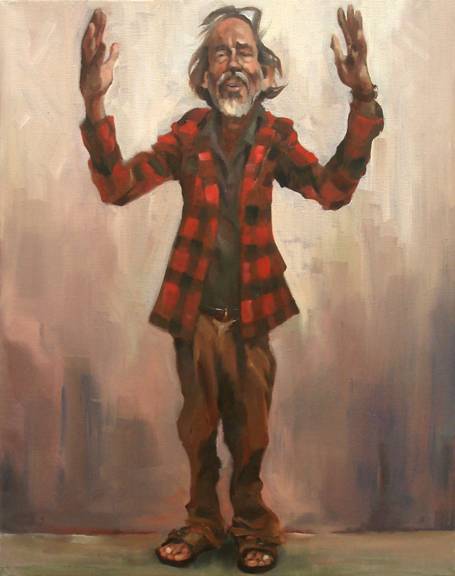
A portrait by Daniel Oltmans for his senior art show project.
I think I was telling Daniel Oltmans how long I had been on this project, “annotating wedding… about 50 years…”
I must observe that my Sabbatical project brought some surprises. I knew I had acquired some good pictures and recalled strong memories, but I did not know what a mixed response I would get when I wrote or called every person whom I could remember. Indeed, as I commented above I tried to reach anyone in whose weddings I had a part. I started out by sending letters, emails and making phone calls. I am grateful to Jack Marshall at Westminster College and several folks in the Alumni Office at the UOR. I was overwhelmed some days with the memories and reflections of those I tried to contact. Their responses confirmed the value of the project this semester and all the days I spent going to weddings for half a century now. Without their responses, this would be a very dull CD. I appreciate the support of Catherine Walker at every point in this project; and I could not have obtained the "album project" in this format, without the wonders of "HTML" and Jared Moore.
The Sabbatical gave me a chance to look back over many decades in my life. On some days, I was thrust back into the time of a wedding, long ago, and far away…as if I was re-living them. Also I had some special moments on the phone, reading email and thinking of how to put into my “album project” in a friendly mode. I know many different views can be evoked as there are readers. For example, a good friend whose wedding is discussed above commented, , “Reading what you wrote made me think it was a kind of sermon.” I was somewhat shocked, but I realized later that he meant what he said in a good sense…it was like a sermon with some sense of edification. Thanks, again, to all who asked me to have some part in a memorable wedding and to all who sent reponses that brought this project into life.
Appendix • Reading Selections for Weddings.
• Sources Cited throughout the whole “album”
From Elizabeth Barrett Browning, read “How do I love thee…”
Or perhaps a poem from Shakespeare?
Look in the the Oxford Book of English Verse for
“Bridal Song”
Roses, their sharp spines being gone,
Not royal in their smells alone,
But in their hue;
Maiden pinks, of odour faint,
Daisies smell-less, yet most quaint,
And sweet thyme true;
Primrose, firstborn child of Ver;
Merry springtime's harbinger
With harebells dim;
Oxlips in their cradles growing,
Marigolds on death-beds blowing,
Larks'-heels trim;
All dear Nature's children sweet
Lie ‘fore bride and bridegroom's feet,
Blessing their sense!
Not an angel of the air,
Bird melodious or bird fair,
Be absent hence!
The crow, the slanderous cuckoo, nor
They boding raven, or chough hoar,
Nor chattering pye,
May on our bride-house perch or sing,
Or with them any discord bring,
But from it fly!
(Quiller-Couch, ed. Oxford Book of English Verse, 191-2, but perhaps the author was John Fletcher)
Also read
“A Bridal Song”
by John Fletcher
“Cynthia, to they power and thee
We obey.
Joy to this great company!
And no day
Come to steal this nigh away
Till the rites of love are ended,
And the lusty bridegroom say,
Welcome, Light, of all befriended!
Pace out, you watery powers below”
Let your feet,
Like the galleys when they row,
Even beat;
Let your unknown measures, set
To the still winds, tell to all
That gods are come, immortal, great
To honour this great nuptial!
Perhaps the poem is better to be used as at toast at the reception, come to think of it,
Or even when all the guests are gone from view, when bride and groom are at last alone together. ( Oxford Book of English Verse, 241)
Helen, my wife, and I attended different universities where we each read some Milton and later taught his poetry. We did not, however, select a poem of Milton for our wedding. Perhaps, were we to redo the wedding, we might pick from “Poems of the First Period” when Milton looked so young, as the painting of him in the National Portrait Gallery, above.
But literature majors might find inspiraton from reading Milton inspirational. For example read this one:
"Enamoured, artless, young on foreign ground,
Uncertain whither from myself to fly,
To thee, dear, Lady with an humble sigh
Let me devote my heart, which I have found
By certain proofs, not few, intrepid, sound,
Good, and addicted to conceptions high;
When tempests shake the world, and fire he sky,
It rests in adamant self-wrapt around,
As safe fro envy, and from the outrage rude,
From hopes and fears that vulgar minds abuse,
As fond of genius and fixed fortitude,
Of the resounding lyre, and every muse
Weak you will find it in one only part,
Now pierce by Love's immedicable dart. "
( Eng. Tr. by Milton of Italian “Sonnet VI”, (1628), Hanford 58)
'Ode on a Grecian Urn'
Thou still unravish'd bride of quietness,
Thou foster-child of silence and slow time,
Sylvan historian, who canst thus express
A flowery tale more sweetly than our rhyme:
What leaf-fring'd legend haunt about thy shape
Of deities or mortals, or of both,
In Tempe or the dales of Arcady?
What men or gods are these? What maidens loth?
What mad pursuit? What struggle to escape?
What pipes and timbrels? What wild ecstasy?
Heard melodies are sweet, but those unheard
Are sweeter: therefore, ye soft pipes, play on;
Not to the sensual ear, but, more endear'd,
Pipe to the spirit ditties of no tone:
Fair youth, beneath the trees, thou canst not leave
Thy song, nor ever can those trees be bare;
Bold lover, never, never canst thou kiss,
Though winning near the goal - yet, do not grieve;
She cannot fade, though thou hast not thy bliss,
For ever wilt thou love, and she be fair! Ah, happy, happy boughs! that cannot shed
Your leaves, nor ever bid the spring adieu;
And, happy melodist, unwearied,
For ever piping songs for ever new;
More happy love! more happy, happy love!
For ever warm and still to be enjoy'd,
For ever panting, and for ever young;
All breathing human passion far above,
That leaves a heart high-sorrowful and cloy'd,
A burning forehead, and a parching tongue. Who are these coming to the sacrifice?
To what green altar, O mysterious priest,
Lead'st thou that heifer lowing at the skies,
And all her silken flanks with garlands drest?
What little town by river or sea shore,
Or mountain-built with peaceful citadel,
Is emptied of this folk, this pious morn?
And, little town, thy streets for evermore
Will silent be; and not a soul to tell
Why thou art desolate, can e'er return. O Attic shape! Fair attitude! with brede
Of marble men and maidens overwrought,
With forest branches and the trodden weed;
Thou, silent form, dost tease us out of thought
As doth eternity: Cold Pastoral!
When old age shall this generation waste,
Thou shalt remain, in midst of other woe
Than ours, a friend to man, to whom thou say'st,
"Beauty is truth, truth beauty," - that is all
Ye know on earth, and all ye need to know. http://englishhistory.net/keats/poetry/odeonagrecianurn.html
Poems by e.e.cummings.
we are so both and oneful
night cannot be so sky
sky cannot be so sunful
I am through you so i e.e. cummings
(he does not use capital letters)
“somewhere I have never traveled”
somewhere I have never traveled, gladly beyond
any experience, you eyes have their silence;
in your most frail gesture are things which enclose me,
or which I cannot touch because they are too near
your slightest look easily will unclose me
though I have closed myself as fingers,
you open always petal by petal myself as spring opens
(touching skillfully, mysteriously; her first rose
or if your wish be to close me, I and
my life will shut very beautifully, suddenly,
as when the heart of this flower imagines
the snow carefully everywhere descending
nothing which we are to perceive in this world equals
the power of your intense fragility: whose texture
compels me with the colour of its countries,
rendering death and forever with each breathing
(I do not know what it is about you that closes
And opens; only something in me understands
The voice of your eyes is deeper than all roses)
Nobody, not even the rain, has such small hands"
e.e. cummings (found in Kingma, 123-4) Although I have never used poem in a ceremony yet, it had a powerful force
in it in March 2007 especially as I remembered hearing the author read at Duke University in the 1960s.
“The Passionate Shepherd to his Love”
"Come live with me and be my love,
And we will all he pleasures prove
That valleys, groves, hills and fields,
Woods, or sleepy mountain yielkds.
And we will sit upon the rocks,
Seeing he shepherds feed heir flocks,
By Shallow rivers to whose falls
Melodious birds sing madrigals.
And I will make thee beds of roses
And a thousand fragrant posies,
A cap of flowers, and a kirtle,
Embroidered all with leaves of myrtle.
A gown made of he finest wool
Which from our pretty lambs we pull;
fairlined slippers for the cold,
with buckles of the purest gold;
a belt of straw and ivy buds,
with coral claps and amber studs;
and if these pleasure may thee move,'
come live with me and be my love.
the shephers' swains shall dance and sing
for thy dlight each May morning;
If hese delights they mind may move,
Then live with me and be my love".
By Christopher Marlowe. (Kingma 82-83) I did get to use this one in the wedding in 2008 at Paso Robles).
“The First Wedding in the World”
by Joel Rosenberg
The eighth day was the wedding.
He awoke amid a dewy moss,
and saw to swans gliding
between the cattails. It was dawn
His side felt sore. He felt
a yearning where before
he'd felt protected, like a dream
had stolen out of reach.
It still was early,
and the moon still gleamed,
and crickets still posed
questions to their answering chorus.
Two large lions sat nearby,
amid the mist,
placidly gazing at the tiny rabbits
nibbling lettuce in their grassy niches.
II
The man had never seen an angel.
He thought it strange
that rainbow-colored fire
took on human image.
When he met Michael
and Gabriel, who told him
they were witnesses,
he thought their garments
Were cascades of golden leaves
their eyes a burning agate,
and their wings
a wreath of northern lights.
He called some names,
and beast and fowl
perked up their ears,
and forest noises filled he air.
III
God made the woman
waiting for him near the meadow
standing on a shell,
her hair down to her knees.
She thought I all so strange,
this garden, jabbering animals,
this stranger standing dumbfounded
and stuttering out her name in joy
She'd never seen a wedding canopy,
the golden gauze
was spun by angels
in the middle of the night.
She thought herself
a thousand years of age,
though looking like a girl of twenty.
All the sad, expensive wisdom
Of society about to waken
in her bones, the secrets
of the wind and stars,
the human arts
Of strife and cultivation,
tincture of the eyelids,
epic meters, and, as ell,
concealments and apologies.
She smiled at the young man's
innocence, while, lovingly,
and for forever, she held out
her hand to him.
IV
The two of them,
with honeybees weaving among
the wreaths of flowers
at their brows,
The two of them,
with hope for clothes,
and no disqualifying memories,
and nothing that was not
Within them from the start,
the two of them joined hands
and stood before the shimmering light
to make their vows. " June 19, l977 written in honor of the wedding of Linda and William Novak ( Diamat 221-3 ). I found it relevant to the wedding I imagined between Adam and Eve above in " Weddings around the World."
Bethany Reeves send me her list of some one liners she found while preparing for her wedding described above in the last decade. They might be better used on programs than read during the ceremony. Her research is as follows:
“May God, the best maker of all marriages, combine your hearts in one.” ~ William Shakespeare
“There is nothing nobler or more admirable than when two people who see eye-to-eye keep house as husband and wife, confounding their enemies and delighting their friends.” ~Homer, The Odyssey
“Two souls with but a single thought, two hearts that beat as one.” ~Von Munch-Bellinghausen, Ingomar the Barbarian
“Omnia vincit Amor; et nos cedamus Amori.” (Love conquers all; let us yield to Love . ) ~ Virgil, Eclogues, X
“Some pray to marry the man they love, my prayer will somewhat vary, I humbly pray to heaven above, that I love the man I marry!” ~Rose Pastor Stokes, My Prayer
“Oh happy race of men, if Love, which rules Heaven, rule your minds.” ~Boethius, Consolations of Philosophy
“He who finds a wife finds a good thing, and obtains favor from the Lord.” ~, Proverbs 18:22
“ Be likeminded, having the same love, agreeing together, being of one mind.” ~ St. Paul , Philippians 2:2
“May yours hearts be comforted, being knit together in love.” ~ St. Paul , Colossians 2:2
“A virtuous women is more precious than jewels, and her value is far
above rubies. The heart of her husband trusts in her with confidence;
she will comfort, encourage, and do him good all the days of her life.”
~ Proverbs 31:10-12
“A man shall leave his father and mother, and shall cleave to his wife, and they shall be one flesh.”
~"Adam" as quoted by the Yahwist in, Genesis 2:24
“Love is as strong as death; many waters cannot quench love, neither can the floods drown it.” ~ , Song of Solomon 8:6&7
“Love endures long, and is kind. Love bears all things, believes
all things, hopes all things, endures all things. Love never fails.” ~ St. Paul , I Corinthians 13: 4&7
“Live joyfully with your wife, whom you love, all the days of your life.”~ Ecclesiastes.
Recently a collection of poems by one of my daughter's old favorities for the music if not the words appeared by Sting. The poem is a more a hope for a wedding than a wedding poem, but I like it. Some couple will use it someday, I feel sure.
From “Lyrics By Sting” “I spent a year working on a Disney animated film Kingdom of the Sun with my good friend and virtuoso pianist Dave Hartley. The same team that made the very successful Lion King commissioned us to write a series of songs for various characters set in the Andean kingdom of the Incas.
" The project was cursed from the beginning. The director left, the script and plot would change on a weekly basis, and I was getting more and more despondent. Then one day the studio called to tell me they have uncovered some demographic research claiming that modern children switch off mentally when characters start to sing. So they didn’t want songs to be attached to characters or plots, they just wanted generic musical backgrounds. I was disappointed, to say the least, pointing out that my favorite Disney movie, The Jungle Book, would never have been completed if such research was correct.
"Eventually the movie itself morphed into a comedy called The Emperor’s New Groove and was released in 2000. I provided an end-title song, which was nominated for an Oscar.” "My Funny Friend and Me
In the quiet time of evening
When the stars assume their patterns
And the day has made his journey
And we wondered just what happened
To the life we knew
Before the world changed
When not a thing I held was true
But you were kind to me
And you reminded me
That the world is not my playground
There are other things that matter
What is simple needs protecting
My illusions all would shatter
But you stayed in my corner
The only world I know was upside down
And now the world and me
Know you carry me You see the patterns in the big sky
Those constellations look like you and I
Just like the patterns in the big sky
We could be lost, we could refuse to try
But we made it through
In the dark night
Who would those lucky guys turn out to be?
But that unusual blend
Of my funny friend and me I’m not as clever as I thought I was
I’m not the boy I used to be because
You showed me something different
You showed me something pure
I always seemed so certain
But I was really never sure
But you stayed
And you called my name
When others would have walked out on a lousy game
And look who made it through
But your funny friend and me You see the patterns in the big sky
Those constellations look like you and I
That tiny planet and the bigger guy
I don’t know whether I should laugh or cry Just like the patterns in the big sky
We’ll be together ‘til the end this time
Don’t know the answer or the reason why
We’ll stick together ‘til the day we die If I had to do this all a second time
I won’t complain or make a fuss
Who would the angels send?
But that unlikely blend
Of those two funny friends
That’s us"
|