Adam and Eve’s Wedding
www.wutsamada.com
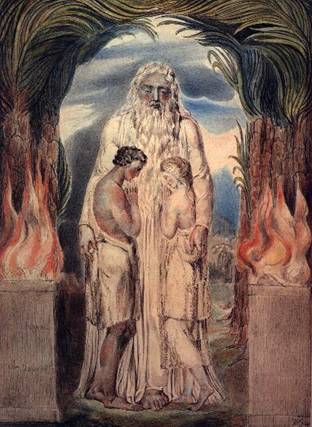
In the image above William Blake captured for us what seems to be a wedding. Actually the title is “the clothing of Adam and Eve.” The icon above will take a reader through a series of weddings which appear in the reading of Hebrew Scriptures. Then, some weddings in other Near Eastern cultures and finally commentaries of Medieval Jewish Rabbi which deal with weddings and marriages.
Those who know the story behind the image above will remember that Adam and Eve were at the Gates of the Garden of Eden, expelled and guarded by the fire. That story as found in the Book of Genesis seems to convey to me suggestions of a wedding ceremony. The author of the Genesis wedding story was, according to many Biblical scholars “the Yahwist.” In any case the author of this ancient story wrote about a man and a woman in a garden, where they first met and were married, and included the strange comment, “A man shall leave his father and mother and cleave unto his wife.” We were Adam and Eve's father and mother?
I have used those same words in wedding ceremonies, and at least the line:
“Bone of my bones, and flesh of my flesh." I once offered a modern free translation, “Wow, this mate of mine is just what I have been searching for!” The 20th Century bride and groom smiled, I remember.
In the illustration of Blake, the Divine Being was portrayed as twice the size of the humans, and he seems to be bringing the two together. Is it a wedding when there are no other witnesses? Not in the State of California today. One needs two witnesses to sign the appropriate form, and some one in authority, a sea captain, a judge, priest, rabbi or minister must also pronounce them "husband and wife" and sign the same form with no mistakes, with no white outs, no lines drawn through a word, or even messy handwriting, as I learned only too well!
As I reflected on “The Wedding of Adam and Eve," I imagined myself (as any reader can do so as well) being present at this wedding. Perhaps, dear reader, you will join me in "crashing" this most famous of unions at what appears a wedding. Please do so, otherwise only I and the serpen,t who has not yet made his presence known, would be the only sentient beings who might sign a wedding license for our ancestors.
In fact, whatever be the mythological dimensions of this first wedding, many followers of three of the great, living world religions (Judaism, Christianity and Islam) have told and retold the stories of Adam and Eve as a beginning to the human race. A warning to readers! I decided to crash a number of weddings in my space/time defying vehicle which took me back to this wedding, which I had never imagined before. In so doing, I realized that it was importantour earliest ancestors properly wed.
In the era before ancient peoples learned to write and read, what did they do in wedding ceremonies? Probably we shall never know. But this story in Genesis was “as good as it gets” for capturing the feeling of union, blessed by the Divine Being. So, clearly, this was a religious ceremony, and it later earned a place in Genesis when the Yahwist was inspired to write about it.
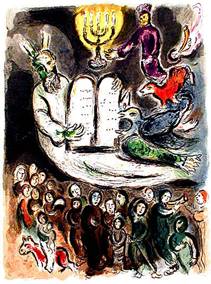
As for Moses, he holds a pivotal role in Hebrew Scriptures and is seen by traditionalists as the author of the first five books. Moses is more often remembered as the lawgiver as in the image created by the great 20th Century Jewish artist Marc Chagall below.
It is curious that if Moses wrote the Book of Exodus why he told so little about his own wedding? We do read that when he fled Egypt, Moses picked the daughter of Jethro, Zipporah, who watered his sheep to be his wife. We also learned that Moses was a protector for the women at the well from the local "hooligans" who did not know how to treat women.
As for the additions to the story about Moses being sought by the daughter of the Pharaoh, I always knew they were inventions by Cecil B. DeMille for his film “The Ten Commandments.” Not even DeMille dared film or even impled that there might have been a fancy Egyptian wedding in Egypt for Moses. If so how could Moses (played by Charlton Heston) have overcome the advances of Nefetiri (played by Anne Baxter), the daughter Rameses (played by Yul Brynner)? In any case, Moses was remembered more for getting the Hebrew slaves out of Egypt (as in the 14th Century, Spanish Haggadah now in the British Museum portrayed below) than for any wedding he had.
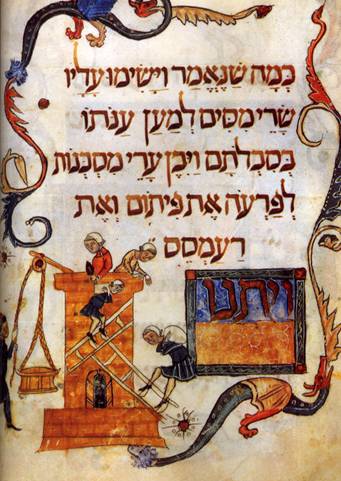
(Korn, 71). I have ofen used this image of Hebrew builders in my Hebrew Scriptures “Blackboard” syllabus, and I confess it has nothing to do with weddings. But it is beautiful with Hebrew vowels pointed by the medieval Massoretes, the same vowels I learned in Hebrew 101 to help us pronounce the vowel-free consonants!
In my research for this project, I found a source that would not have been allowed by my graduate school advisors in Will Durant, who wrote about the beautiful Jewish women from a "pure" race among the "ethnic cross-currents of the Near East" (Herberg I, 303). I wonder if this paragraph was written as the Nazi's took power in Germany in the l930's, if he did so in direct contradiction of Hitler's ideology.
Durant continued "their (Jewish) women painted their cheeks and their eyes, wore all the jewelry they could ge, adopted the est of their ability the newest styles of Babylon, Nineveh, Damascus or Tyre." He continues with commentary on the Ten Commandments, and on the seventh which he wrote "recognized marriage as the basis of the family.....that love affairs probably occurred, for there was much tenderness between tghe sexes: 'Jacob served seven years for Rachel, and they seemed unto him but a few days for the love he had for to her'....before the Exile marrige was completely secular, arranged by parents, or by the suitor with the parents of the bride" (Durant, 336).(For my thanks to another reader of Will Durant, cf. under the "Decade" -"1974-89 ) "Wedding of Elizabeth Moore and Jonathan Salk" in 1980).
In a quite different place in the Hebrew Scriptures we find the Book of Ruth, by an unknown author. Probably the Book of Ruth was written to show the lineage of King David from a Moabite woman thereby to generate openness to marriage between Jews and Gentiles. In the Book of Ruth, a woman from Moab, who had married one of the sons of Naomi, returned to the land of Israel upon the death of her husband and her father-in-law. The beautiful and simple story has proven a wonderful means by which to teach students the Hebrew language in the last decade at the University of Redlands. The author of Ruth does not reveal the form of a Hebrew wedding ceremony except in the scene in which Ruth comes to Boaz, for what might be a betrothal and the scene when Boaz makes his promise known. Is that a wedding? The author saw fit to demonstrate witnesses were important, and property was agreed upon.
Ruth had been married once already by the time the story opened, but immediately he, his brother, and his father soon all died. (Ruth 1:3) Thus, when Ruth goes with her mother-in law back to Israel, Naomi seems to have had hope for a second marriage for Ruth. Hard working and focused in her new language, Ruth worked like many immigrants all over the world, then and now, to feed Naomi and herself by gleaning fields. She is soon notieced by a kind and openhearted man, Boaz, who allows her to glean.
www.galerieart.cz
When Naomi learned of Boaz's interest in Ruth, she knew in her heart that
Boaz
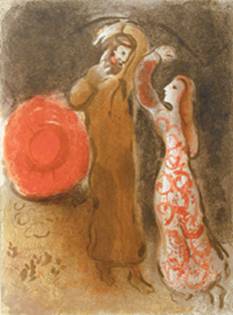
was the right man and she told Ruth she should wait until Boaz was well fed and a bit drunk and then to go to him in the night. Here in the illustration above by Marc Chagall, Ruth gets ready to “spread her skirt” before him, which the Good News translators rendered, “Marry me.” Boaz agrees and tells her he will return in the morning, whereupon he gathers 10 elders, and after finding and clearing his desire with the nearest relative of Naomi and her family, who does not want to marry Ruth. The land which he owns would be part of the wedding contract with Ruth, so Boaz would have to promise the land to the descendents of Ruth. This story is especially important to the collectors of Hebrew Scriptures since King David's ancestry is traced back to Ruth. Another important dimension of the story of Ruth is that it shows David was of “mixed” ancestry. He has a Moabite great-grand-mother. That fact seemed to be no big issue for the author of the Book of Ruth, fp r after all, Ruth had already promised Naomi, "Your people shall be my people, and your God shall be my God." Ruth was becoming a convert to Naomi's religion.
As for the wedding, what we read is that Boaz negotiates a contract with Ruth and family. The marriage is about property rights (pre-nuptial agreements) and having proper witnesses. The form of the marriage is a custom called “levirate” (Havilland, 220); it was a way for a widow to “maintain the established relationship with her family and their rights over her sexuality and her future children: it acts to preserve relationship previously established.” Boaz clearly understood the practice; and it was he, Boaz who first speaks in the story of their ceremony. Ruth did not. She had already spoken, no doubt the narrator of the story knew, when she said the previous night, “Marry me.”
In that case the betrothal, wedding, and consummation, all took place in a few hours. (cf. the next exposition under "Christian weddings" and learn
Martin Luther liked "quick weddings"). My brother, Betts, and his wife, Martha, who are featured later in this "album project" on the "Timeline" on “the 60’s,” borrowed the line “Whether thou goest, I will go,” from Ruth to use in their wedding ceremony and as an inscription on their rings. Theirs was a promise still being fulfilled as they went on a journey together to Korea for twenty years and thereafter to serve a small church in Florida, and now to retirement in Clearwater.
While researching the Book of Ruth, I found the interesting question raised by Rabbi Roger Ross: “If Ruth did it, why shouldn’t I….” on web link:
http://www.lovetrack.com
There I read the following:" So today, as a practicing rabbi, when I hear someone say that a rabbi shouldn't conduct an interfaith ceremony because it is wrong or that it is against Jewish tradition and law, I refer them to the Torah, the five books of Moses in the Hebrew Scriptures. My first question is, "Who did Moses (the most important man in Jewish history) marry?" Moses' wife was Zippo rah, whose father was as a priest of another religion, and according to history was black. I also relate the story of Esther, for whom an entire book of the bible was written. Esther, whose real name was Hadassah, we celebrate on Purim because she saved the Jewish people from extinction. She changed her name to Esther, which was a Persian name, so she could marry the king who certainly wasn't Jewish. My third question is "Who is the most revered woman in the bible?" Most people say that it is Ruth, who has an entire book written about her. Ruth was not Jewish. She married twice to Jewish men, and after the second one died, her mother-in-law, Naomi told Ruth that she was going back to her people and that Ruth should do the same. That is when Ruth answered with one of the most famous lines in the Bible as she said to Naomi, "Whither thou goest I will go. Your people are my people. Your God is my God." How can I conduct an interfaith marriage? How can I not?
During the Babylonian Exile, there were also marriage ceremonies from which the Jewish exiles might have borrowed some ideas. In ancient Babylon (c. 1800 BCE) the Code of Hammurabi dealt with marriage and many other topics.
Eichrodt (1959) noted that “the Priestly Code” (Lev. 20) has details similar to the Book of the Covenant (Exodus) which make it “hard to resist the impression we are here confronted with a part of the material missing from that book (i.e. Exodus). One passage deals with the punishment for those caught in acts of sexual misconduct and its is to be noted that these offences are on the whole more severely punished in Israel than in Babylon. Indeed, he wrote, in Israel the death penalty was the general rule, but in Babylon the latter a fine or banishment was the punishment which fits the crime. (Code of Hammurabi 134-137). Hammurabi has many images in the Google link:
He left his image as well as his code of laws.
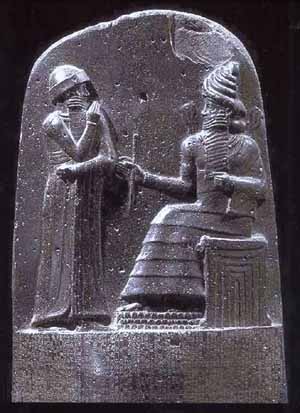
The Code of Hammurabi deals as with such things as the re-marriage of a “divorced wife to her first husband, assuming that in the meantime she had married another man and then been released from that also either by death or divorce, The Code of Hammurabi also deals with laws of the rights and obligations of prostitutes, for even some of them made it to weddings as a bride, it is clear. (Eichrodt, 82 citing Code of Hammurabi 108-111; l27; 178).
As well as influences from the Code of Hammurabi, the ancient Jewish culture had influences by rituals from nearby cultures in the form of hieros gamos (“sacred marriage”) in between the goddesses and the rulers which had been transformed in to the Sukkoth (Feast of Tabernacles) during the first month of the new year (in the fall season, with agricultural harvest but “which had both sexual and covenantal overtones…the rite of marriage developed into a legal and religious act in Judaism and into a sacrament in Roman Catholicism and Eastern Christianity.” (Boalt, 159).
Several of the prophets in the Hebrew Scriptures give us hints of wedding ceremonies. The most famous of them was Hosea, who was told to marry a prostitute, and in doing so felt he was following God’s instructions. An editor of the oracles of God to Hosea has added a complex biographical background to what we find later in the book (Hosea 1-3). Probably Hosea had a first marriage to Gomer (Hosea 1).
On Google an image of Gomer appears almost like a modern “facebook” image. I must confess that I had never thought of her as such a beautiful woman. But my brother Betts assures me that she must have been. To be a prostitute either at a temple or in her own private brothel, she would have to have been beautiful to attract men to her.

http://www.christcenteredmall.com/profiles/gomer.jpg.
There is more to say than meets the eye with the image of Gomer, as above. In the Book of Hosea, there was “A divine divorce and remarriage as a symbol of restorative confrontation” (Wyrtzen, 320 and Hosea 2:20-23) Thus, there were two marriages or weddings , one may have been described in the first chapter and in the second chapter there was a new wedding with Gomer in which the second marriage reveals God’s grace as symbolized in what Hosea acts out. I think the vow that Hosea spoke was his vow in that wedding ceremony (or betrothal). I came to this conclusion in an unpublished thesis (Huntley, l961) and expanded on it more thoroughly later, when I concluded that “in the nuptial imagery of Hosea there is evidence of a legal institution of marriage; the (language about the image) preserves some of the legal language and forms of vows” (Huntley l964, 32). (Both these two studies were written by me on the eve of my wedding described in "Decades" and "1960s" and Hosea's language was used by Helen and me in our own ceremony instead of the vows in the Methodist prayerbook used elsewhere in our wedding).
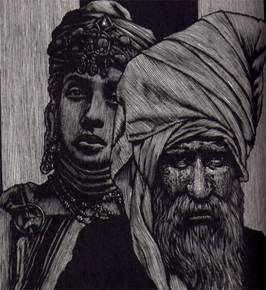
Illustration by Moser
The image above captures a powerful sense of sadness in Hosea’s face, which Hosea certainly believed that God shared with him. For his wife had betrayed him, just as Israel had betrayed God. Gomer does not look so good herself. Perhaps this image captures the mature Hosea and Gomer in their second wedding ceremony (Hosea 2:20-23). In the first marriage Gomer seems to have had a difficult time remaining faithful, and thereby she may have gone into the second marriage seeking forgiveness and promising faithfulness this time around. My experience is that second marriages in America today, as perhaps in ancient Israel, are more likely to have a successful duration than in first ones, especially when the couple seems to have gone in the first wedding without much reflection on events which might happen in the difficult years to follow. Hosea probably did not need the line “for better or worse” in his second wedding. He already knew the worst could happen!
But Hosea’s use of the imagery is not to be understood only at the legal level. Language of the heart is found in abundance in Hosea’s imagery.” (Huntley, l964, 32). I think that Hosea was trying to show the steadfast love (hesed) for Israel as indeed he was trying to express his human love for his wife through what must have been a very difficult personal time. Max Weber wrote with respect to the idea of covenant (Berithin Hebrew) that one of the first (prophets), Hosea, could immediately conceive of the religious meaning in relation to God in terms of a marriage.” (Weber, l21).
Moving out of the Prophetic (Neviim) section of the Hebrew Scriptures and into the “Writings” (Kethuvim), I discovered that the English poet Edmund Spenser was inspired by the Hebrew poems in the Song of Songs or Song of Solomon.
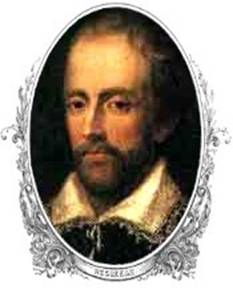
http://spenser.classicauthors.net/pictures/Edmund,Spencer.jpg
Psalm 45 and Song of Songs are often considered Epithalamia at least from the time when Edmund Spenser applied the term. Famous for the “Fairie Queen,” Spenser was a translator of the Song of Songs and took a line of his translation of the Hebrew poem, “Thy necke is like a tower of ivory” (Song of Songs 7:5) and when he wrote his poem “Epithalamion” used a similar line “Her snowie necke lyke to a marble towre” (sic. Epithal, 177 cf. Baroway, 83).
In a recent comment on the Song of Songs, Grossberg (240) noted “Humanity, nature and love converge in the poetry:
How sweet is your love, my sister, my bride!
How much better is your love than wine?
And the fragrance of your oils than any spice!
Your lips distill nectar, my bride;
honey and milk are under your tongue;
the scent of your garments is like the scent of Lebanon (Song 4:10-11)”
Source: www.davidmoss.com/books.htm
A wedding poem (epithalamion) appears in the Hebrew Scriptures (Psalm 45). Scholars take the poem as a composition for a wedding celebration of a Hebrew king and his queen to be and later allegorized where the place of the king was taken by God and the place of the queen as the people of God (the Jews, by the time the collection of Psalms were determined). The poem does not seem to capture the words that the king and his queen to be were to say in the ceremony, but rather the poet takes on the role of an omniscient observer who gives advice to each of the nuptial pair as they approach the moment of their marriage.
Psalm 45 is clearly takes us to the wedding of a Jewish king with a foreign princess. Later in the formation of the Hebrew Scriptures in Babylon and thereafter, Psalm 45 was included in the Book of Psalms when the King was taken to be God, and the bride was taken to be the Hebrew people.
I found images of “Jewish kings” in Google to be bleak, but image below of Solomon and Sheba seem to suggest that Solomon could not keep his hands off her, perhaps off any women. In any case, we are not certain that Psalm 45 was written on the occasion of one of Solomon’s many weddings.
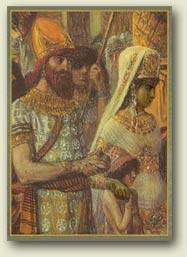
sheba.org.il/history.php
At this point in researach about ancient Jewish weddings I consulted two old volumes I have owned for 50 years, long before I imagined this "album project." First was Roland De Vaux (1961) who wrote as follows:
In ancient Israel the “engagement, or betrothal, is a promise o marriage made some time before the celebration of the wedding. The Hebrew word ‘arash appears 11 times in Hebrew Scriptures. We find the word in the piel imperfect with an accusative object “to become engaged to..” (Deut. 20:7). This use is interesting for it us employed by the writer in the circumstance that the young man, to get engaged. It would have been easier than going to Canada.
For use of the term used when the subject of the clause is a woman cf. the pual, participle me’orasah “become engaged” (Ex. 22:15 and Holladay, W. (1971) A Concise Hebrew and Aramaic Lexicon of the Old Testament, based on the Lexical work of Ludwig Koehler and Walter Baumgartner. Leiden: Brill), when engaged, i.e. not married, is excused from war. Were that our practice in the USA during the Vietnam War, there would have been thousands perhaps millions of young men eager
Sometimes the engagements are peculiar. “Though Rebecca was promised to Isaac in Mesopotamia, the wedding took place only when she joined him in Canaan (Gn. 24:67); Jacob waited 7 years before marrying, but he had a special contract with Laban (Gn 29:15-21)" (De Vaux, 32).
The story of the Queen of Sheba (I Kings10) certainly does not contain the text of what might have been used as a wedding ceremony or he stipulations that would become part of a contract of exchange of goods but it seems clear “that the daughty queen made her long journey” to do more than “speak riddles with Solomon…and view his rumored splendors” (Kitchen 118).
Kitchen goes on to suggest the encounter was not merely romantic interest which drew her there, but he argues the visit was to confirm an ancient route between Jerusalem and S. Arabia which would bring gold and other materials to Solomon. Instead of giving up this route by land Hiram of Tyre who had already sent Solomon a wife were trying to set up a sea route that would have eliminated all or part of the land round to Sheba. Her journey was a success, so “she (and her putative husband- Solomon?) need not have worried; he passing of both Hiram and Solomon brought an end to their shipping line, whereas the camel-borne aromatics caravan trade was destined to last for well over another millennium. (Kitchen 11) Thus we find economic advantages to nuptial connections in ancient times, far more valuable that the so call “Bush-tax cuts!
Now, let us consider how a psalm, written on the occasion of a wedding of a king, could be repeated in order to perpetuate the “virginity” of women who were attending. We have comments by Jerome, who spent some years in Bethlehem, translating the Hebrew Scriptures into Latin as the Vulgate in Letter 65, (cited by Hunter, 294) offers a “a more ascetic interpretation of Psalm 45”…. Especially when dealing procession of the virgins, her companions; by contrast, we find in Song of Songs the reader finds queens, 890 concubines and maidens without number. (Song of Songs 6:8-9) finds Jerome offering, “a hierarchy based on ascetic merit.” The ones in the first rank are the 60 queens who have preserved in virgin both body and soul …next are widows and married people the 80 concubines.
My research for comments for my “album” led me back to influences upon Hebrew Scriptures. The bad news coming out of Iraq every day since January when I started this project, reminded me daily that a civilization between the Tigris and Euphrates Rivers had been there long before the Jews were taken there as captives.
I found a translation of the laws relating to marriage in the Code of Hammurabi from c. 1720 BCE. In #128 (Pritchard) one reads “If a seignior (Italian is used for a “free man” but it can suggest a “noble”, a “free man of any class”, or just a “man from slave to King”) acquired a wife, but did not draw up the contracts for her, that woman is no wife.”
That statement shows the necessity of written documents, contracts, for marriages to be legal. The same requirement exists in the State of California today; a license is a contract. In addition there may be “pre-nuptial agreements” about property and possessions filed in a court.
Moreover, I discovered, “If the wife of a seignior has been caught while lying with another man, they shall bind them and throw them into the water (Pritchard #129) If the husband (lit. owner or master) of the woman wishes to spare his wife, then the king in turn may spare his subject (lit. slave).” This law seems to be based upon events which take place after a wedding and not likely to have been brought up in the ceremony itself, although the study of such laws before weddings took place might have benefited both men and women in ancient Babylon. I found interesting the fact that both man and woman were to meet the same fate, i.e. being thrown into the river. Actually, it was not an automatic death sentence, for what if one or both were able to swim, or one were to seek to save the other in the water?
Off interest to me was the fact that the husband of the woman might plead with the king to save the life of his wife. Is this a hint of forgiveness or practicality? But the man found in bed with another man’s wife, was he to be thrown into the river whether or not anyone pled for him? If there is a parallel from which we can learn anything, laws in several of the states of the USA allow a husband for finds his wife “lying with another man” may execute one or both without penalty, if he invokes revenge immediately, or does not go have a drink and think about what he should do.
Then about a thousand years pass, archaeologists have found more laws in the Neo-Babylonian period which was the time of the Jewish Exile in Babylon which might have easily influenced the last stages of the formation of the Torah (Genesis-Deuteronomy) and even more the scribes and scholars of Judaism in the Talmud, especially the version on Babylon. We read, “In the case of a seignior, who gave his daughter (in marriage) to a (noher) seignior’s son and the father set down a certain amount o the document and gave (it) to his son and the seignior set the dowry (i.e. marriage gift) for his daughter and they wrote a contract with one another—they may not contest their contract. The father many not make a deduction from anything that he wrote down or his son on the contract and indicated to his (son’s father-in-law. If when fate carried off the father’s wife (i. e.she died) he has acquire another wife and she has born him children, the children of the later (wife) shall take one third of the remainder of the property" (Pritchard, #9, 197). This example suggests that things have gotten more complicated in a thousand years, but written contracts as part of a marriage were important and need to be signed before the marriage began.
These laws may suggest the developing complexity of law and even the need for law schools to interpret such complex issues. But the overview is that contracts are essential, and they are abiding. No “deductions” are possible. Also it seems that the two fathers are more important in those times than the son and daughter being married, as least as the legal protectors of property and dowries. I might observe that on California wedding licenses the names of the fathers and mothers of both bride and groom are recorded as are their birthplaces.
Interesting!
The oldest hard copy (manuscripts) of Jewish documents dealing with marriage contracts, were found in Upper Egypt from the 5th Century BCE. There in Egypt the Jewish community left in the Aramaic language of the Persian period, but written in the Block Letter Characters recognizable today a clear form of wedding contracts as follows:
1. Date with the day month, year of the rule of the Persian emperor.
2. Names and setting, the bridegroom was the initiator of the contract, and he name of the agent of the bride.
3. Oath of the bridegroom “she is my wife and I am her husband from this day forever”
(Cowley 15. line 4)
Conditions such as the giving of the Mohar first to the bride and then gifts to the groom. The will stating what will happen on the death of the husband
- Breaking of the contract, with the vow the bride would make, and what the groom would say to dissolve the contract and with transactions of goods of goods.
- Lists of scribes and witnesses.
Were these inventions of the Jews? Probably not, for there also Egyptian people mentioned in many of the papyri. An important stage may be seen in the Elephantine documents where one bride left three documents for each of a Jewish woman named Mibtahiah who had three marriages as follows: first to Yezaniah, a good Hebrew name with the “y” prefix; a second marriage to Ashor, also a good Hebrew name; and finally, at least third to Pi, whose religion she also adopted. (Cowley, 41-50). be more likely a “pre-nuptial” agreement with very specific lists of who brought which items into the marriage.”
During the compiling of the Talmud, Jewish scholars debated the importance of marriage.
Rabbi Jacob said: “he who has no wife lives without good, or help, or joy, or blessing, or atonement”: Rabbi Joshua of Sikhnin in the name of Rabbi added that such a man is also without life. Rabbi Hiyya ben Gammada said that he is not really a complete man, and some say that he dismisses the Divine Likeness, (Cf. Bereshit Rabbah, 17:2) (Browne, 272).
There will be a section in my “album” which deals with Modern Jewish Weddings. But for a conclusion to this section, I will share an image on a vellum manuscript from Germany in 1427, signed by the scribe Isaac Ben Simhah Gansmann who used a corner of his page to portray a man waiting in his bed, sometime after a wedding while his wife prepares to join him, but first she immerses herself in a mikvah, ritual bath. I do not take my viewers into many honeymoon moments in this “album,” but bear with me for this one. I like it! Sorry, I cut off too much of the surrounding Hebrew text, but I will be happy to work through the full page with anyone who will do so with me!
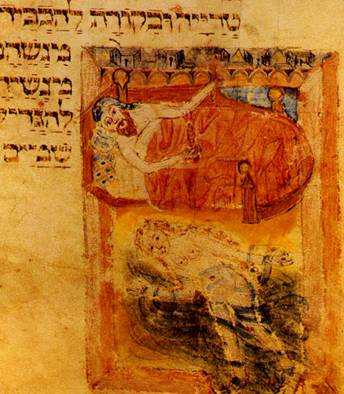
(Korn, 20). I shall continue this exposition of weddings into the Medieval Jewish community of Europe, and in another link in my album treat modern Jewish weddings as a separate section.
Still looking for forms of ceremonies in the Jewish communities of the diaspora, especially in Europe which afforded Jews the opportunty for continue to study and teach Jewish traditions and the need to do so against the threat of persecution and sometime even exterminations, I found some important teachings. In the SEFER HASIDIM, one finds instructions as to "the purity of family life" and "precise details as to "the intimate life of man and wife" (Zinberg, 50). There I did not find a ceremony as such but an implied injunction toward marriage. For example, one reads:
"Let a man no say...'I am so poor; how can I take a wife? I 2will not have te wherewithal to support her.' He who thinks thus is one of those who lack faith. He, too, who as bread only for the present day and worries about wah he will live on tomorrow is of those who lack faith" (Sefer Hasidim, #519, Zinberg,50. The present writer must report that on the eve of his own wedding, he might have well considered himsedl as "one of those who lack faith" but for the generosity of the Duke University Graduate School which awarded a generous fellowship for doctoral studies).

image" zinberghistjewishlit.jpg
In the SEFER HASIDIM one also finds wisdom regarding child-rearing. If a son finds the study of the Bible easy, for example, but the "Talmud is difficult for him, you should not press the isse and demand of what he now study the GEMARA. Let him learn what he understands..."(#308, Zinberg, 51). Meanwhile, if the father has daughters, "every father is obligated to study Torah with his daughters also, to familarize them with the laws and commandments." (#313, Ibid).
In other sections of this "album project" I wrote about four weddings which I had either attended or performed in which a person of Jewish ancestry marries a person who has had no Jewish ancestors, I pondered what kind of instruction a medieval rabbi or commentator would have for such a wedding. I also knew that in the medieval era in Europe that Jews were reading Socrates or Plato. Others knew of Homer and also of the allegorical method of interpreting Scripture. Jews knew of Origen, Augustine, and Abelard and in resonse one Jewish Biblical exegete, Joseph Bechor Shor, responded, "The Christians...see int he words of Moses our teacher only allegores and parables and do not intgerpret a single word with its true meaning" (Zinberg, 108). I thought I could assume from this reaction that no rabbi or exegete could imagine having anything to say to a Jewish boy who was to have a wedding with a Christian. (as for example in the "album project" when I wrote about the wedding of Chelsea Clinton ("decade" "the new century).
So I turned to look at Maimonides' "Guide for the Perplexed" knowing that the author had lived a very successful life among Muslims in Spain and in his journey to Jerusalm, where he must have known Jewish brides or grooms having weddings outside the faith of their ancestors. |